
 All
All
 Dobson
 Refractors
 Ed & Apochromates
 Newtonian reflector
 Schmidt Cassegrain
 Maksutov-Cassegrain
 Solar
Solar
 Researcher
 Focal reducer
 Intelligent
 All
All
 Equatorial
 Alt/Az
 Harmonic
 Tripods
 Accessories
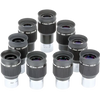 All
All
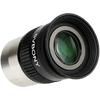 Wide angle
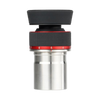 Zoom eyepieces
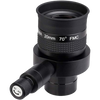 Reticulated eyepieces
 Barlow
 Plössl
 Binoculars
 Atmospheric Corrector
 All
All
 Visual
 Photo
Photo
 Polarisants
 Solar Filters
 Accessories
 All
All
 Color Cameras
 Monochrome Cameras
 Planetary/Guiding
 Objectives
 All
All
 Binoculars
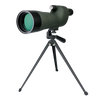 Spotting Scope and Monocular
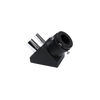 Elbows
 Optical Divider
 Mirrors
 All
All
 Bags and protections
 Supports and counterweights,
 Camera adapters
 Focuser
 Collimation
 Heating band
 Cables
 Collars
 Computers
 Fans
Fans
 Others
 All
All
 Weather Station
 Thermometer
 All
All
 Observatory/Domes
 Accessories
 Askar
Askar
 Baader
 Bresser
 Celestron
 Dwarflab
 Explore Scientific
 GSO
GSO
 iOptron
 Optolong
 ScopeDome
 SkyWatcher
 SVBony
 Touptek
 Vaonis
 Vixen
Vixen
 ZWO
ZWO
[Guide/Comparison] ZWO Cameras: Which Series to Choose to Get Started in Astrophotography?
Choosing your first astrophotography camera may seem confusing given the variety of models on offer. At ZWO, several series – ASI, ASI-Cooled, or ASI Mini – offer specific features depending on your level of experience and observing goals. This guide has been designed to help you understand the technologies at play and identify the ZWO series best suited to your needs.
1. Understanding the purpose of an astrophotography camera
Unlike a standard camera, a astro CMOS camera optimizes light capture on very faint objects. ZWO popularized this type of sensor thanks to its simple interface (often via USB 3.0) and its compatibility with most capture software such as SharpCap or ASICAP. The main advantages of a dedicated camera:
- A sensitive sensor with low electronic noise, for precise long exposures.
- A fine parameter control: gain, temperature, binning…
- Easy control on an equatorial mount via autoguiding.
The choice of the right series will therefore depend on the type of observation aimed for: planetary, deep-sky, or autoguiding.
2. The different ZWO camera series
2.1 ASI Series (uncooled)
The standard ZWO ASI models are the ideal entry point for beginners. They are lightweight, easy to use, and cover a wide range of astronomical images.
- Advantages : excellent value for money, universal compatibility, compact build.
- Disadvantages : sensor that heats slightly during long exposures, which can increase image noise.
Recommended for : lunar, planetary captures, the Sun (with a suitable filter) and the first deep-sky images without a cooling system.
2.2 ASI Cooled Series (cooled by a Peltier module)
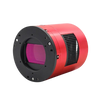
The ASI-Cooled cameras incorporate an active cooling system that stabilizes the sensor temperature. This thermal regulation significantly reduces thermal noise and enables longer exposures, essential for the deep-sky.
- Advantages : ideal for nebulae, galaxies and clusters; better long-exposure image quality; stable temperature.
- Disadvantages : higher price; external power supply required for the Peltier module; increased weight.
Recommended for : astrophotographers wanting to progress toward high-sensitivity scientific or artistic imaging.
2.3 ASI Mini Series
The ASI Mini cameras are designed for the guiding. Compact, they are typically mounted on a guiding scope to keep an accurately aligned equatorial mount during long exposures.
- Advantages : very lightweight, effective at guiding star detection, low power consumption.
- Disadvantages : smaller sensors, not suited for capturing main deep-sky images.
Recommended for : accompanying a main camera on a long-exposure imaging setup.
3. Essential criteria for choosing well
- Sensor type (CMOS, color or monochrome) : Monochrome versions offer more finesse and sensitivity, but require LRGB filters. Color sensors are easier to use for beginners.
- Sensor size : Influences the field of view. A large sensor is ideal for extended galaxies, while a small sensor makes focusing easier for planetary.
- Resolution and pixel size : The smaller the pixels, the more detailed the image will be, provided you have quality optics and a stable mount.
- Connection type : Check USB 3.0 compatibility, 12V power (for cooled models) and software compatibility with your computer or tablet.
- Mount type : Most ZWO cameras use a standard threading (1.25”, 2”) compatible with eyepieces and adapters of modern telescopes.
4. Practical comparison according to your profile
| Profil utilisateur | Série conseillée | Main objective |
|---|---|---|
| Beginner in planetary imaging | ASI (uncooled) | Moon, planets, Sun (with a specific filter) |
| Amateur progressing toward deep-sky | ASI Cooled | Nebulae, galaxies, clusters |
| Experienced user optimizing their guiding | ASI Mini | Autoguiding and tracking precision |
5. Practical advice before purchasing
- Evaluate the optical compatibility: back focus and optical length must be matched to your telescope or refractor.
- Also invest in appropriate accessories: filter wheel, adapter, quality USB cabling, stable power supply.
- Prefer well-known third-party software (FireCapture, NINA, PHD2) to get the most from your camera.
- Don’t forget that the equatorial mount plays as essential a role as the camera: tracking stability takes precedence over sensor size.
Conclusion
Choosing the right ZWO camera comes down to balancing budget, complexity and observing goals. An uncooled camera will be suitable for starting without technical constraints, while the Cooled series will meet the long-exposure ambitions. The Mini versions establish themselves as a reliable guiding solution for demanding sessions. By clearly defining your priorities – type of celestial object, observing environment, and level of experience – you will find the series that best fits your practice and will foster your progression in astrophotography.