
 All
All
 Dobson
 Refractors
 Ed & Apochromates
 Newtonian reflector
 Schmidt Cassegrain
 Maksutov-Cassegrain
 Solar
Solar
 Researcher
 Focal reducer
 Intelligent
 All
All
 Equatorial
 Alt/Az
 Harmonic
 Tripods
 Accessories
 All
All
 Wide angle
 Zoom eyepieces
 Reticulated eyepieces
 Barlow
 Plössl
 Binoculars
 Atmospheric Corrector
 All
All
 Visual
 Photo
Photo
 Polarisants
 Solar Filters
 Accessories
 All
All
 Color Cameras
 Monochrome Cameras
 Planetary/Guiding
 Objectives
 All
All
 Binoculars
 Spotting Scope and Monocular
 Elbows
 Optical Divider
 Mirrors
 All
All
 Bags and protections
 Supports and counterweights,
 Camera adapters
 Focuser
 Collimation
 Heating band
 Cables
 Collars
 Computers
 Fans
Fans
 Others
 All
All
 Weather Station
 Thermometer
 All
All
 Observatory/Domes
 Accessories
 Askar
Askar
 Baader
 Bresser
 Celestron
 Dwarflab
 Explore Scientific
 GSO
GSO
 iOptron
 Optolong
 ScopeDome
 SkyWatcher
 SVBony
 Touptek
 Vaonis
 Vixen
Vixen
 ZWO
ZWO
Vaonis Vespera II : the revolution of the connected telescope continues
A new perspective on the sky
Imagine observing the spiral arms of Andromeda from your garden, without complex alignment or a fixed eyepiece to stare through. In a few minutes, your tablet transports you to millions of light-years away. This experience, once reserved for seasoned astronomers, is now accessible thanks to a new generation of instruments: connected telescopes. And in this field, the French company Vaonis stands as a pioneer. With the Vespera II, it continues the metamorphosis of the way we observe the sky.
The concept of the connected telescope
Traditionally, astronomical observation rested on pure optics: lenses, mirrors, and patience. But connected telescopes combine optics, digital sensors, and software intelligence. They capture photons from the depths of the cosmos, translate them into digital images, and display them instantly on our screens. The observer becomes a visual explorer, able to stack exposures to reveal details invisible to the naked eye.
This concept arose from a simple observation: many hobbyists give up astronomy for lack of knowing how to orient or adjust an instrument. Connected telescopes simplify everything: no need to adjust the mount or master deep-sky photography. The software handles mounting alignment, star pointing, and real-time image processing.
From Stellina to the Vespera II: the evolution of an idea
Vaonis had already made a name for itself with Stellina and the first Vespera. These instruments had inaugurated a new relationship to astronomy: a collective, convivial and technological practice. The Vespera II continues in this same lineage, but pushing each aspect further: higher resolution, better sensitivity, refined image processing, and even more intuitive use.
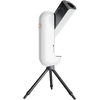
The principle remains unchanged: a compact and elegant design housing a closed optical system, protected from dew and dust. Its built-in camera captures the sky and sends the images to a dedicated mobile app. The user selects their target (nebula, cluster, or galaxy), and the telescope automatically orients itself. This is the promise of a smooth and immersive experience.
The standout innovations of the Vespera II
If the first model had already won over enthusiasts for its ease of use, the Vespera II goes even further. Its larger sensor improves the finesse of details and the field of view, allowing for richer and more contrasted images. The onboard processing enables faster image stacking, revealing the structures of spiral galaxies, the filaments of nebulae, and the subtle hue of star clusters.
Another advantage: automatic focus adjustment, essential when temperature changes throughout the night. The telescope adjusts its optics automatically, ensuring sharp captures from dusk to dawn. Coupled with precise sky tracking, it can accumulate hours of perfect exposure, whether you are in the countryside or on an urban balcony.
A collaborative and educational experience
Beyond technology, the Vespera II embodies a new way of sharing astronomy. The companion app allows you to follow the live evolution of the capture, save your images, and share them instantly. Observing becomes a collective activity: we choose targets together, we discover the photographed objects, we learn to recognize constellations and cosmic distances. Teachers and club coordinators also see it as an educational opportunity to introduce astronomy without intimidation.
In short, this instrument no longer imposes solitary astronomy behind an eyepiece, but opens the way to connected, participatory and even contemplative astronomy. It brings scientific rigor closer to digital culture.
The symbol of the democratization of the sky
One of the major challenges of public astronomy has always been the technical barrier to entry. Set up an equatorial mount, align the celestial pole, calculate the tracking: so many steps that discourage the curious. Connected telescopes, of which the Vespera II is a flagship, reverse this logic. They transform an activity for initiates into an experience accessible to all, in a single click.
This democratization of the sky is not just a gadget of a hyperconnected society: it rekindles the ancient bond between humans and the stars. Since the dawn of time, we have sought to understand these bright points. Today, thanks to more intuitive tools, everyone can reconnect with this original fascination.
Towards a new era of amateur exploration
The combined power of miniaturization, digital imaging, and software intelligence leads us toward an unprecedented era: that of augmented observation. The Vespera II symbolizes this convergence. It does not replace human curiosity; it prolongs it. We still gaze at the same sky, but with new eyes, capable of piercing the depth of the cosmos and understanding it a little better.
And who knows? These 21stst century telescopes may open the way to a global network of amateur explorers contributing to scientific discoveries, as comet observers did in the past. Because behind every captured pixel lies a story of light, a fragment of the universe ready to be rediscovered.
Conclusion: the future is at the end of the virtual eyepiece
The Vaonis Vespera II is not only an optical instrument, it is a bridge between tradition and innovation. It confirms that the passion for the sky can evolve without losing itself. By blending design, automation and sharing, it opens the way to a new generation of amateur astronomers, curious and connected.
Observing the sky, yesterday as today, remains a wonderful way to put our world into perspective. And in this quest, technology does not erase wonder: it magnifies it.